


Introduction
Nowadays, it seems like the cost of everything has gone up be it household ration, petrol, rent or monthly bills. This is the first thing people say: “Expenses have skyrocketed, but income remains the same.” This situation is called “Cost of Living Crisis”, where it becomes difficult to meet daily needs.
In the UK, the ONS reports that inflation in the past two years has hit average household budgets hard, forcing people to spend more judiciously on even the basics (ONS, 2023). When inflation rises and salaries stagnate, one feels not only financial distress but also mental stress. According to Mind UK (Mind, 2023) and the NHS (NHS, 2024), the fear of not being able to meet everyday expenses is leading to anxiety, burnout, irritability and hopelessness. Financial stress disrupts sleep, affects relationships and creates insecurity about the future.
Understanding the Cost of Living Crisis
What is Inflation?
The easiest way to understand the Cost of Living Crisis is to understand inflation. Simply put, when the prices of things rise rapidly and incomes do not rise at the same pace, it becomes difficult to make a living. In the past few years, according to the ONS, the prices of basic necessities such as food, electricity bills, house rent and petrol have all risen significantly (Office for National Statistics).
Who is Affected the Most?
The crisis hits low-income people, students, single parents and large families particularly hard, as they already have limited opportunities to save. Students often seem to decide to buy books or eat cheap food to get them through the month. Families have to think whether to provide for the children or pay the electricity bill at the end of the month.
Everyday Impact on Lifestyle
Common everyday examples include people using the heater less to lower bills, skipping meals, forcing themselves to buy cheaper items, or some people cutting back on groceries for an entire month to pay the rent. People are now thinking more seriously about the difference between “necessity” and “luxury”.
All these changes are not only financially exhausting but also create emotional stress. Constant reckoning, fear of running out of money, and uncertainty about the future add to mental anxiety, and stress. Thus, inflation is not only an economic problem, but also affects the mental state of daily life.
Psychological Impact of Financial Stress
Constant Anxiety
The first and most noticeable effect of financial stress comes in the form of constant anxiety. When income is limited and expenses are increasing rapidly, one keeps thinking about the same thing day and night: “How will I pay the next month’s rent? Where will the electricity bill be met? Will the children’s fees be collected on time or not?” This constant worrying keeps the human mind in a state of high alert, as if a new problem could arise at any moment.
Most of the people feel alone in this problem, because they are not able to share their financial problems with others. Even a small problem becomes a huge burden on the mind—a car breakdown, a sudden medical expense, or the breakdown of an essential item. Even these minor emergencies create intense panic and anxiety in the individual.
Disturbed Sleep
Sleep is also affected due to financial stress. Even when people go to sleep at night, they are caught up in calculations which bill to pay first? What to delay? These thoughts do not allow the mind to rest. Many people experience insomnia, frequent awakenings, or nightmares because of this.
Negative Thinking & Emotional Exhaustion
Since the mind is constantly under stress, it also affects the way of thinking. Lack of money creates negative thinking, self-doubt, and uncertainty about the future. Some people feel as if they have less control over their lives no matter how hard they try, things just aren’t getting better.
Feeling Stuck
Financial stress often puts people in a situation where they feel completely stuck as if there is no room for change. When expenses are not met despite months of effort, deep despair sets in, and it seems that no improvement is possible in the future. This feeling can gradually turn into depression, which results in the individual becoming discouraged to work, make plans, or try something new.
Social Withdrawal
People withdraw from friends and family, cut back on socializing, and hide their hardships, because experiencing financial hardship often brings them shame. Many people begin to see themselves as failures, even if the real problem is economic conditions and not their ability. Thus, financial stress drains a person’s mental energy and makes him emotionally lonely.
Impact on Family Relationships
Conflict Between Partners
Financial problems often affect the home environment the most, especially when lack of money becomes part of everyday decisions. Many couples tend to argue over issues like spending money, saving, or paying bills, which gradually puts a strain on the relationship. Sometimes one partner feels that the other is irresponsible, while the other feels weak or a failure.
Parental Guilt
Parents also experience intense feelings of guilt when they are unable to provide for their children’s needs or wants be it school fees, clothes, or some small pleasure.
Caregiver Burnout
Also, caregivers at home, such as mothers or the head of the family, suffer from emotional burnout due to constant stress. They lose their mental and physical energy by taking care of outside problems and household responsibilities. As a result, tension builds up over petty issues at home, misunderstandings arise, and the overall family atmosphere is filled with uneasiness.
Impact on Self-Worth and Identity
Income Equals Self-Worth
Financial stress has a profound effect on a person’s self-worth. When income is low or expenses are not met, many people begin to weigh their ability, hard work, and status on the same scale as if their value equals their income.
Shame Around Seeking Help
According to the APA’s stress reports, financial problems often make people feel inadequate or weak, even if the real problem is the economic system, not their personal abilities. Lack of money makes people feel embarrassed to borrow or ask for help, because they fear that they will appear weak in front of others.
Social Isolation
The Mental Health Foundation reports that people experiencing financial difficulties often become lonely, as they avoid social get-togethers, parties, or meeting friends outside to save money. This process of isolating themselves gradually increases their mental burden, and they begin to think that they cannot enjoy life like others.
Thus, budget constraints not only hamper the pocket but also deeply affect a person’s confidence, self-esteem and way of thinking about themselves.
Social Consequences of the Cost of Living Crisis
Cost of Living Crisis doesn’t just change the household budget but affects the structure of the entire society.
Widening Inequality
When prices rise and incomes remain the same, there is a marked increase in inequality. The gap between the rich and the poor widens, as people with low incomes find it difficult to meet even their basic needs.
Increased Food Bank Use
In the UK, the Trussell Trust reports that the number of people seeking help from food banks has increased sharply as food prices have risen (The Guardian). People not only borrow food, but are often forced to take on extra jobs or work part-time to make ends meet.
Reduced Social Activities
Social activities have become a “luxury” due to inflation, causing people to cut back on meeting friends, eating out, or going to events. This behavior gradually increases loneliness and social isolation, which has profound effects on mental health.
Delayed Life Decisions
The situation is becoming difficult for the youth as well. Due to rising costs, many young people are delaying decisions such as marriage, further education, or moving to a different home, as they do not consider themselves financially stable.
Workplace Pressure
Pressure has also increased at workplaces. Employees are in constant fear of losing their job, losing hours, or not getting a raise, making the work environment even more stressful.
The Vicious Cycle: Money Problems → Mental Health Issues → More Money Problems
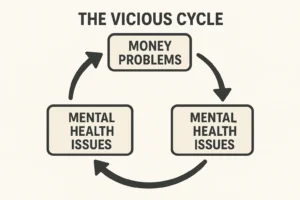
Financial stress creates a cycle that is often very difficult to break out of. When a person is constantly worried about money, their mind is overloaded, and this stress reduces attention, memory and productivity.
Reduced Productivity
According to WHO reports, stress significantly reduces work performance (who.int). People arrive at work late, make more mistakes, or sometimes skip work due to anxiety and depression. This results in lower incomes, and further financial stress starting a never-ending cycle.
Poor Decision Making
Another effect of stress is impaired decision making. When the mind is constantly disturbed, a person either avoids spending, procrastinates on bills, or gets into an emotional state and makes bad financial decisions like taking out high-interest loans or making impulsive purchases. Studies show that people make more irrational decisions during times of stress, which exacerbates their financial problems.
All these factors combine to create a vicious cycle: lack of money affects mental health, and poor mental health leads to more financial difficulties.
Coping Strategies and Support
Many people need help, guidance and a safe support system to break out of this cycle. To deal with financial stress, it is important to first examine your daily habits.
Individual-Level Strategies
Writing down monthly expenses, tracking small expenses and planning ahead with budgeting apps or a simple notebook reduces stress. It is also important to replace negative thinking such as “I will never be able to handle these situations” with realistic thinking such as: “I can slowly improve.” Taking walks, deep breathing exercises, journaling or sharing your feelings with a trusted person can help reduce stress. Getting emotional support from friends and family eases the burden.
Community Support
Many countries have free counseling services, helplines and support groups aimed at helping people with depression and financial problems such as Mind UK or NHS support services. Local charities also provide food support, utility bill assistance or temporary financial assistance in many places, which can alleviate immediate stress. Most importantly, being open about money issues is not something to be ashamed of, but a sign of getting help.
Policy-Level Solutions
Long-term improvements require governments and institutions to provide affordable and accessible mental health systems. People can benefit through measures such as affordable housing, better minimum wages, and energy subsidies. Mental health-friendly policies, flexible working hours, and support programs in workplaces also play an important role in coping with financial stress.

